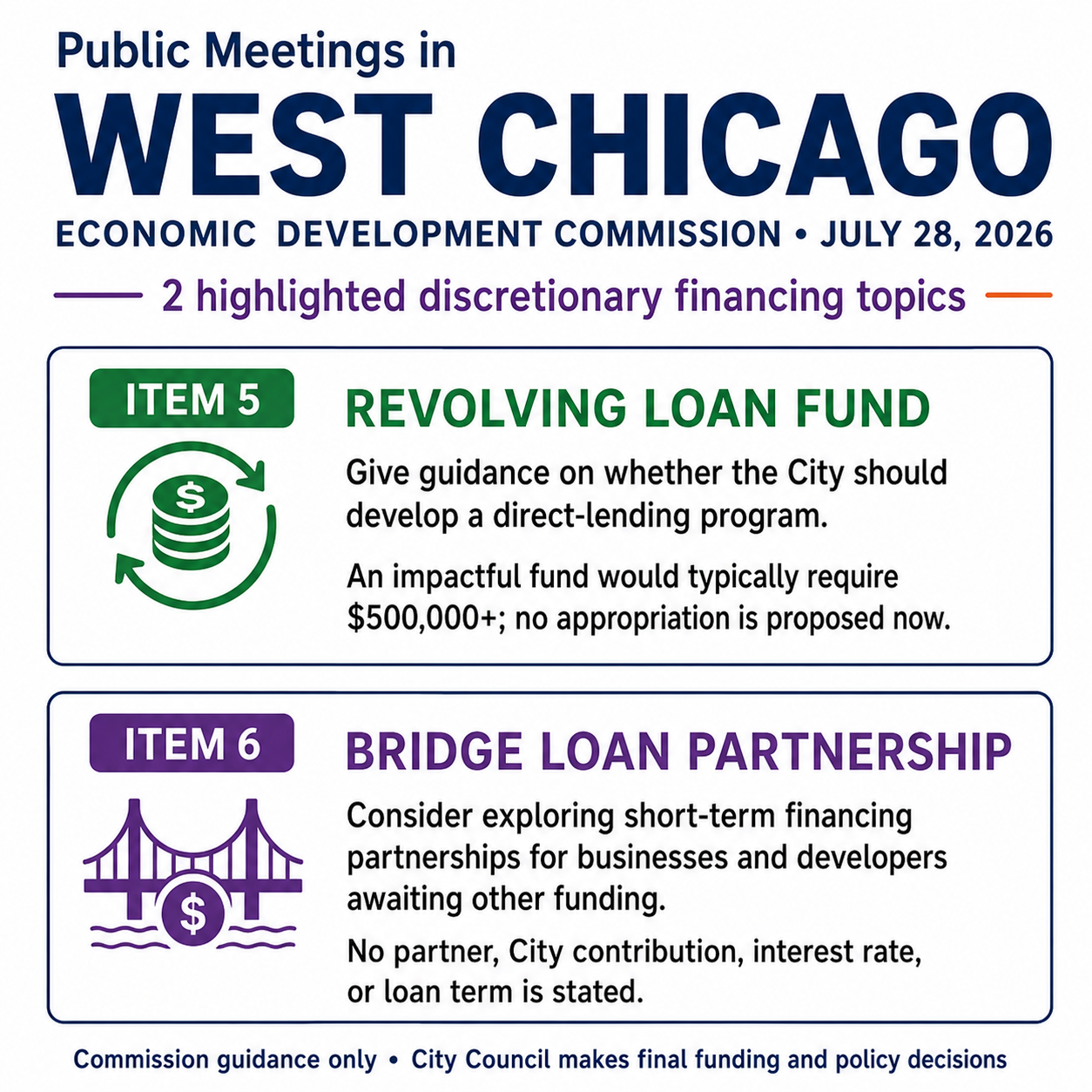
Economic Development Commission discretionary agenda highlights for July 28, 2026

Economic Development Commission Summary

West Chicago Economic Development Commission Agenda Review — July 28, 2026

This table summarizes each Economic Development Commission agenda action, the money involved, and whether the action appears non-discretionary under the review rubric.

Item Short description Money involved Non-discretionary evaluation
4 — Approval of May 28, 2026 meeting minutes Approve the Commission’s draft record of its May special meeting. No direct City expenditure identified. Likely non-discretionary / administrative. Approval maintains the Commission’s official meeting record.
5 — Consideration of a Revolving Loan Fund Give guidance on whether the City should continue as a facilitator connecting businesses to capital or pursue a City RLF for redevelopment, expansion, tenant build-out, rehabilitation, or gap financing; if pursued, identify its purpose and work-plan initiatives to defer. No current appropriation is proposed. Staff says an impactful fund would typically require $500,000 or more, potentially from TIF, the General Fund, EDA or HUD CDBG grants, or another source. Loan sizes, terms, loss reserves, administration costs, and capitalization are not established. Discretionary strategic and financial-policy guidance. Pursuing an RLF would shift the City toward direct lending, financial underwriting, servicing, default risk, and ongoing oversight. The Commission advises; City Council would make any final funding and policy decisions.
6 — Consideration of a Bridge Loan Partnership Consider exploring a partnership with a financial institution, economic-development organization, or nonprofit lender to offer short-term financing while businesses or developers await grant reimbursement, permanent financing, tax credits, or other funding. No amount, partner, City contribution, interest rate, loan term, loss allocation, or administrative cost is stated. Discretionary program-development guidance. The Commission is considering whether to develop a new financing partnership, but this packet does not authorize a program, select a partner, or commit City funds.
7 — Q2 Work Plan Progress Report and FY2027 Priorities Receive the Q2 implementation update and advise whether to retain six high-priority initiatives, defer or reschedule lower-priority work, and consider five emerging initiatives for the FY2027 budget and future Work Plan updates. No specific FY2027 appropriation or project cost is stated. Several emerging initiatives—including rebranding, a statistically valid community survey, downtown construction support, a land-use transition study, an RLF, and a bridge-loan partnership—could require later budget actions, but no amounts are provided. Mixed: informational progress report plus discretionary priority-setting. Receiving Q2 status is informational, while recommending which initiatives to prioritize, defer, or add to FY2027 planning is a substantive policy and resource-allocation choice. City Council retains final budget and Work Plan authority.

Detailed analysis of substantive topics

5 — Revolving Loan Fund

Staff asks the Commission to choose between continuing the adopted 2026–2028 Work Plan’s facilitator model and pursuing a City RLF. The memo says an RLF could address financing gaps for redevelopment, small-business expansion, tenant build-outs, and rehabilitation, with repayments replenishing the fund. It also notes that the Commission has historically favored grants over loans for some incentive programs, questioned whether the City should evaluate private business viability, and shown interest in external financing tools.

An RLF would require a funding source and lending framework. Staff identifies a typically impactful minimum size of $500,000 or more and possible sources including TIF, General Fund money, EDA grants, or HUD CDBG grants. The City would need eligibility rules, underwriting and collateral standards, approval authority, loan-loss reserves, servicing and collections, compliance monitoring, legal instruments, reporting, and auditing. Administration could be in-house, third-party, or hybrid.

The memo identifies default and enforcement risk, specialized expertise, continuing staff workload, and possible duplication of private lending. It also warns that the RLF is not in the adopted Work Plan and could divert capacity from existing priorities. If the Commission recommends proceeding, staff asks it to identify the fund’s purpose and which current initiatives should be delayed or deprioritized.

Decision point: recommend whether staff should continue focusing on the adopted Work Plan or develop an RLF concept for later City Council consideration. No fund is created and no money is appropriated by this Commission action.

6 — Bridge Loan Partnership

The agenda lists bridge-loan partnership consideration as a separate topic, but the packet supplies only the emerging-initiative description within item 7. That description contemplates partnering with local financial institutions, economic-development organizations, or nonprofit lenders to provide temporary financing while businesses or developers wait for grant reimbursements, permanent financing, tax credits, or other sources.

The packet does not identify a proposed lender, eligible borrowers, City capitalization, guarantee, underwriting responsibility, interest rate, maturity, collateral, default exposure, administrative fee, or legal structure. Those omissions are material because a partnership could range from a referral arrangement with little City risk to a City-funded or guaranteed lending program with direct exposure.

Decision point: indicate whether staff should explore partnership models. Any partner selection, financial commitment, guarantee, or program authorization would require a later documented action.

7 — Q2 progress and FY2027 priorities

The Q2 report identifies six recommended continuing priorities: Downtown Modernization and Beautification; West Washington Street redevelopment; business-regulation modernization; the new City website and digital services; downtown housing and redevelopment; and business attraction and marketing. Staff recommends delaying the Retail Lease Trac subscription, rescheduling two workforce-partnership efforts, postponing business-development workshops, and adjusting the timing of the storefront registry, property inventory, and business survey.

The memo also identifies emerging initiatives for possible FY2027 consideration:

Although the memo calls these emerging strategic initiatives, it contains no FY2027 cost estimates or proposed appropriations. The Commission’s input will shape staff planning, but City Council approved the current Work Plan and retains authority over future budget and plan changes.

Decision point: advise whether the identified priorities should remain primary through 2026, whether the proposed deferrals reflect current priorities, and which emerging initiatives should advance into FY2027 budget and Work Plan development.

  • a coordinated City rebranding initiative;
  • a statistically valid community survey;
  • a downtown construction-support strategy;
  • a Grand Lake Boulevard/Elliott Avenue land-use transition study;
  • a revolving loan fund; and
  • a bridge-loan partnership.

Last generated: August 1, 2026 at 7:02 AM CDT